
Monty Python's Life of Brian (1979) ⭐ 8.0 | Comedy
https://www.youtube.com/watch?v=GeKzBQnAq5I
Directed by: Terry Jones
Written by: Graham Chapman, John Cleese, Eric Idle, Terry Gilliam, Terry Jones & Michael Palin
Starring: Graham Chapman, John Cleese, Eric Idle, Terry Gilliam, Terry Jones & Michael Palin
Shot by: Peter Biziou
Edited by: Julian Doyle
Produced by: Tarak Ben Ammar
Monty Python’s Life of Brian follows the life of Brian Cohen (Graham Chapman), which parallels the life of Jesus. Brian is an ordinary Jew living in Judea in the time of Jesus; he joins a movement, the People’s Front of Judea (PFJ), to rebel against the Romans, but, as the plot unfolds, he is accidentally mistaken for the Messiah. The film is basically a depiction of how such a thing can happen; it perfectly captures how blind faith in prophecies can be unstoppable despite their apparent falsity. Life of Brian may be a hilarious satire of mob mentality, but beneath it lies a solemn wake-up call to question our religious beliefs and assumptions.
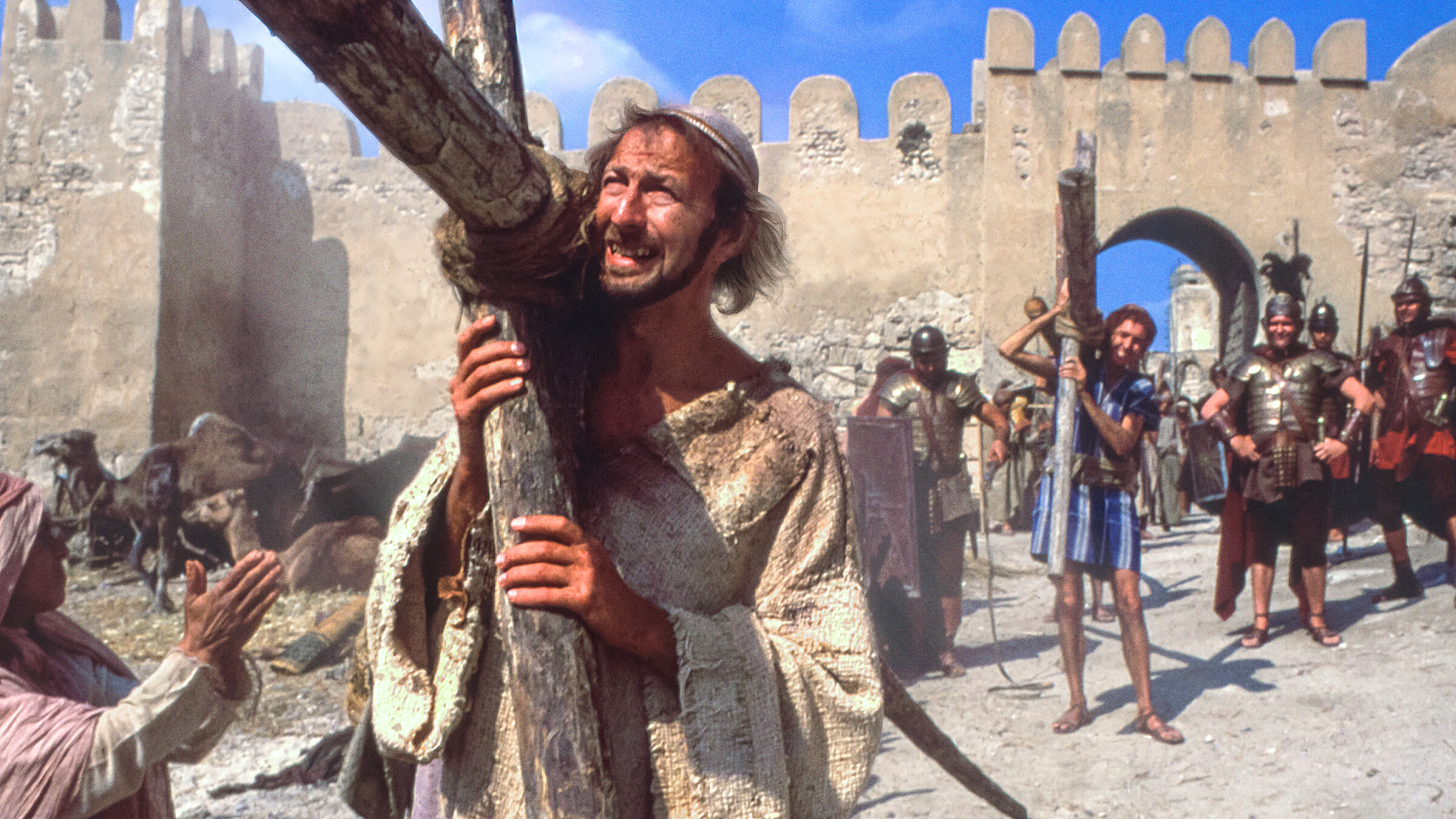
Besides Brian, no other character seems to share the spotlight. There are, of course, his ferocious mother (Terry Jones), his love interest, Judith (Sue Jones-Davies), the members of the PFJ, the various Romans and other individuals, but none of them are particularly interesting—not even Brian himself, who is portrayed as completely ordinary. There is nothing special about Brian, but that seems to work for the film, since he is portrayed as a somewhat objective and distanced witness to all the absurdity that surrounds him; Brian, to a degree, reacts the way we, the viewers, would react to the events of the film. If there must be an interesting character, it should be the people as a collective; the mobs in this film are portrayed as one homogenous living organism. People are—and that is what the film does best—portrayed as mindless fools who are completely incapable of acting as individuals and can only follow the crowd wherever it takes them. This is brilliantly satirised when Brian, who at this point is worshipped as the Messiah, urges a crowd to stop worshipping him and think for themselves, reminding them that they are individuals, and the crowd roars with one voice, “Yes, we are all individuals!”
https://www.youtube.com/watch?v=BgaBuMv_BvA
Life of Brian is another film under the spoudogeloion genre. It infiltrates our screens, hiding a serious warning under the disguise of satire and comedy. Spoudogeloia, as the term suggests, have a two-fold purpose: to entertain and incite laughter and to educate us with a serious moral message. Life of Brian is hilarious; there are plenty of sketches that are just there for laughs and plenty of others that criticise and mock different aspects of humanity; the film is silly, subversive, and biting in its satire. However, its real purpose is to promote a moral and intellectual message: it urges us to think critically, by showing us how the gullibility of our condition distorts our perceptions of the events around us, shaping a false picture of reality, which is established on false, and even silly or plain stupid, beliefs. The film exposes the folly of Christianity by discrediting its unreliable foundations, that is, human experience, human experience shaped by the innate desire to follow the mob like sheep. The film may have been accused of blasphemy, but in fact it does not in any way attack any religious targets; what it does attack is the uncritical attitude of the believers, and their discontent with it is all the more proof that the film hits them where it hurts the most. Not only does the movie succeed in fulfilling its purpose, but it is a major benefaction to humanity and a paradigm of intellectual lucidity, a beacon of hope for a future free from embarrassing religious beliefs.
One scene I really love is when the members of the (PFJ) are sitting during a gladiatorial show and a character named Stan (Eric Idle) keeps interrupting whenever someone says ‘man’ by saying ‘or woman’. This is a surprisingly foresighted satire of political correctness. Stan’s insistence on political correctness keeps throwing everyone off until the conversation cannot continue because of the interruptions. Upon being asked, Stan replies that he wants to be a woman; it is his right, he claims, ‘as a man’. Reg (John Cleese), the leader of the group, surprised by the revelation, asks him why, and he replies that he wants to have babies. The scene continues by depicting the absurdity of one’s entitlement to transgress nature; it asks: What is the point of fighting for unachievable goals? Sometimes, the restrictions placed upon someone’s wishes may not be oppression but the limitations of reality.